When we first shared the framework of Exilic Israeli Trauma (EIT), I did not expect what followed. Messages began arriving from all over the world. From people I know, and from people I have never met. Different countries, different lives. And yet the same experience described again and again.
“I’m not okay, but I feel like I should be.” “I don’t know how to explain what this feels like.” “I thought something was wrong with me.”
One thread kept repeating: guilt. And alongside it, relief. Guilt for not being in Israel. Guilt for being safe. Guilt for struggling at all. And relief, when something they had been carrying for so long finally had a name.
What EIT describes
EIT is not a diagnosis. It is a framework for understanding something many Israelis living abroad have been carrying since October 7.
You built a life away from Israel. Israel is where your identity was formed. So when something happens there, your body responds where your life is. Many people describe disrupted sleep, difficulty concentrating, emotional swings, and a persistent sense of disconnection. They are functioning. Working. Parenting. Showing up. And at the same time, something inside does not settle.
This is not simply following the news. It is the nervous system responding to something it recognizes as real. For many Israelis, the threat is not abstract. It is real and present, encoded and learned over years. The body does not check geography before it reacts.
Exilic Israeli Trauma – Why naming matters
Without language, people turn the experience inward. They assume it is them: too sensitive, too dramatic, not resilient enough. What we have seen clearly is that once there are words, something shifts. People stop feeling alone. They stop feeling wrong. Naming does not fix the experience, but it allows it to be held. Language creates recognition, conversation, and the possibility of seeking support.
What came up in the room
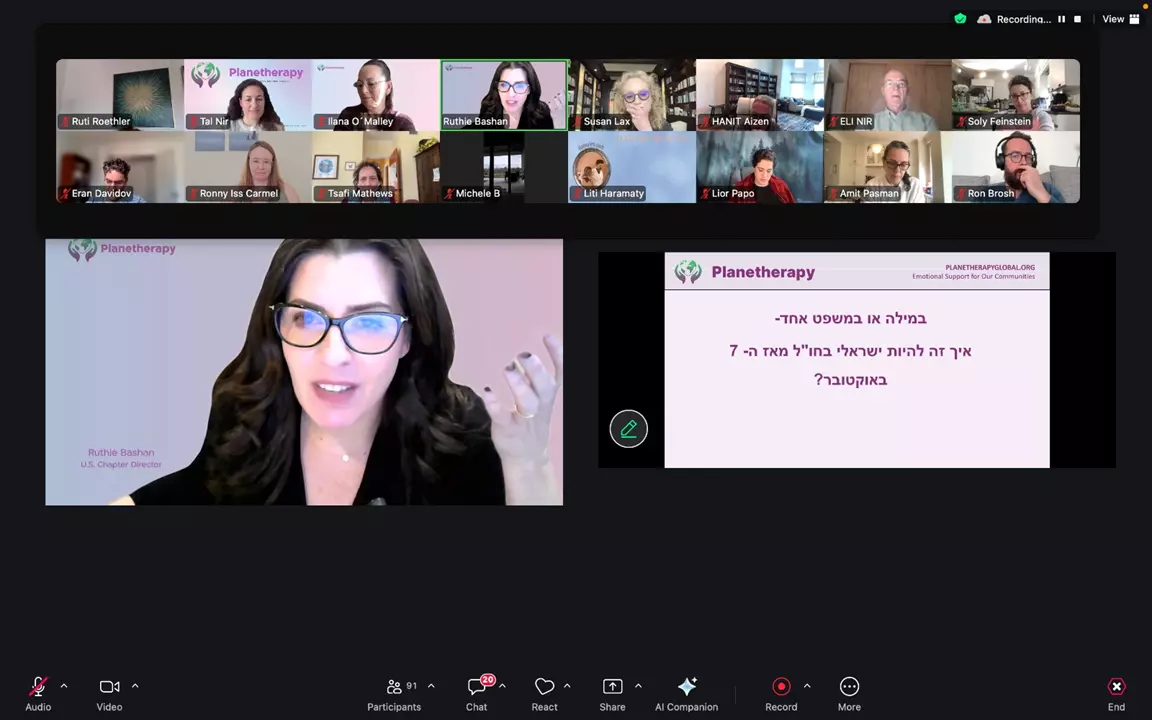
We held a community Zoom with close to 100 participants joining from across the world. It was a structured space for reflection and shared experience, not a therapy session and not a lecture.
None of what surfaced was theoretical. It shows up in daily life: in the parent refreshing the news in the school pickup line, in the professional checking their phone in the middle of a meeting, in the person who laughs at dinner and cries an hour later without understanding why.
During the Zoom, something simple and meaningful happened: people recognized themselves. Some spoke, some stayed quiet, some cried, some just listened. Over and over, the same sentences appeared: “I thought it was just me.” “I didn’t have words for this.” “This is exactly how I feel.”
There was pain in the room. And also relief. And something else that matters just as much: permission. Permission to feel something complex, to not resolve it immediately, to not carry it alone.
Important distinctions
“Isn’t this just anxiety?” There is overlap. But what people are describing is specific and triggered: a headline, a message, a sound, and suddenly the body reacts. Understanding this matters because it shapes how we respond. The body needs to be met first.
“Why call this trauma?” There is a real concern about overusing the word. EIT is not about comparing suffering. It is about recognizing that the nervous system can respond to ongoing, collective threat even from a distance. When people describe sustained disruption in sleep, regulation, and functioning, it deserves attention.
“Is this political?” People come with very different views, and that is real. What we observe, both clinically and in community spaces, is that beneath different positions, similar patterns appear: fatigue, hypervigilance, emotional overload, disconnection. This is about what happens inside the person.
Where this leads
EIT is still a beginning. A way of seeing, a way of naming, a way of opening a conversation that was not fully there before. It also asks something from us as a community: to create spaces where people do not have to explain themselves from the start; to understand that support is both individual and shared; to pay attention to what children and families are carrying quietly; and to allow complexity, without rushing to simplify it.
If something here resonates, you are not the only one. And you are not imagining it.
At Planetherapy, we will continue to hold spaces like this, where what is often invisible can be seen, named, and shared.
About the author:
Ruthie Bashan, MSW, LCSW, MA-AT, recently joined Planetherapy as the US Chapter Director, where she is leading efforts to expand access to trauma-informed emotional support across Jewish communities in the United States.
A licensed clinical social worker and art therapist, Ruthie brings over 20 years of experience in trauma-informed care, community resilience, and Jewish communal leadership. Her work focuses on translating clinical insight into scalable, community-based responses to crisis, particularly in the context of rising antisemitism and ongoing collective trauma.
Ruthie previously served as Director Special Services at the Kaplen JCC on the Palisades and is an adjunct professor at Montclair State University. She has designed and led programs for professionals, students, and community leaders, with a focus on resilience, identity, and practical tools for navigating periods of instability.